Work Stream 1: Classification & Mapping
Work Stream 1: Classification & Mapping
Penholder: Wilfred Wan (SIPRI)
EXPAND explores existing and emerging technologies and mechanisms relevant to nuclear disarmament verification, with view to identifying gaps. This necessitates mapping likely arms control and disarmament scenarios that will manifest. Work Stream 1 seeks to contribute to these efforts through the following steps:
· Elaborate a decision tree that lays out the spectrum of possibilities linked to any arms control or disarmament scenario
· Develop a back-end platform that allows populating scenarios with further details, across the branches of the decision tree
· Identify real world examples that parallel the identified arms control and disarmament scenarios, with particular focus on verification processes
· Based on the above, narrow down scenarios and verification requirements of priority, as ‘needs’ towards which technologies and mechanisms can be focused
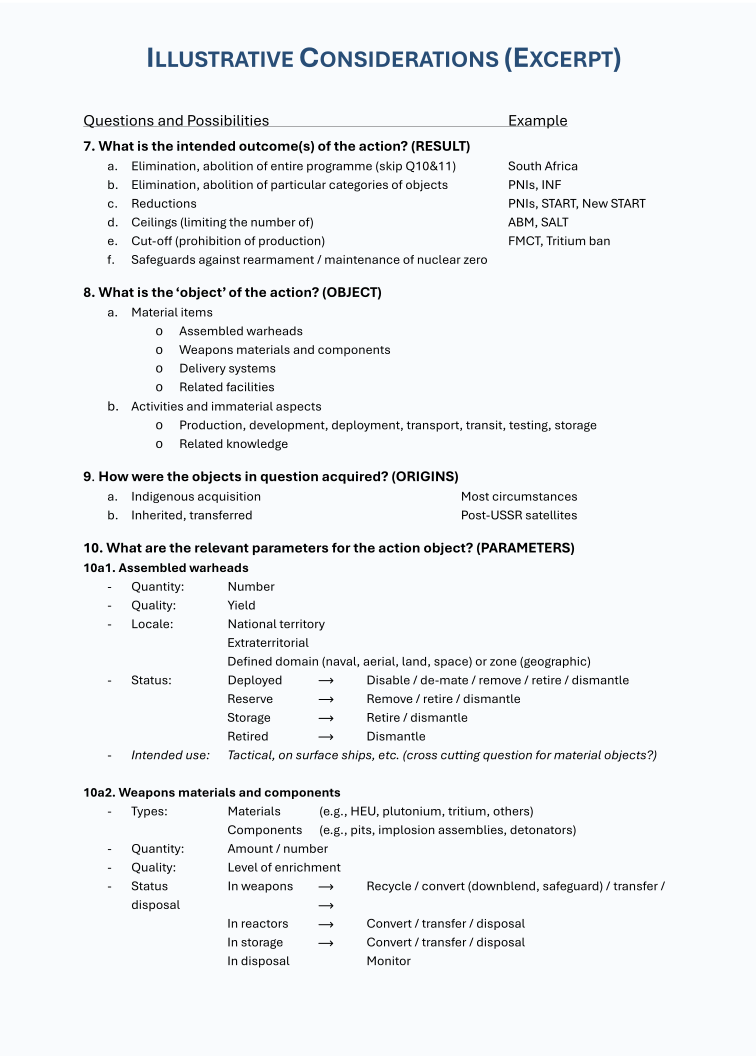
Classification of disarmament scenarios—and their accompanying verification needs—can draw from a number of resources. This includes past precedent, policy proposals, and existing research. Notably, current analyses tend to be framed around individual case studies, with little work considering the totality of scenarios. This mapping exercise, by considering systematically the potential forms of arms control and disarmament, can enable a typology (and hierarchy) of verification needs likely to emerge.
Considerations and Challenges
The many variables involved in arms control and disarmament, including for instance, targeted objects (e.g., warheads, materials, components, delivery systems, related facilities, let alone activities or immaterial aspects), parameters, and contexts, can create an endless permutation of verification scenarios. Here, the use of real-world parallels, drawn from examples past, present, and proposed, can help delimit and establish a hierarchy of priorities. Other complications may arise due to complex disarmament arrangements and conceptual fuzziness.
Next Steps
Identifying a hierarchy of needs is part and parcel of any work pertaining to disarmament verification (including in the context of the future GSTE). Situating these needs into a broader framework - centred on classification of scenarios - can ensure a holistic perspective that avoids duplication of work and enables greater convergence and efficiency.
